

Artificial intelligence has moved quickly from experimentation to a serious business priority. Companies are exploring AI for automation, decision support, customer service, reporting, knowledge access, and operational efficiency. But adopting an AI tool is much easier than making AI useful across a real business environment.
The most common AI adoption challenges are rarely caused by the model alone. They usually come from the systems, data, workflows, ownership, and business decisions surrounding it. A company may have strong AI technology available and still struggle because critical information is inconsistent, applications do not connect, or teams cannot agree on what the AI initiative should accomplish.
For established and mid-sized organizations, the question is not simply whether AI is available. It is whether the business foundation is ready to support reliable, secure, and measurable use. Understanding the barriers to AI adoption early helps companies avoid expensive pilots that never become part of day-to-day operations.
Key Takeaways
- AI adoption is an operating-model challenge as much as a technology challenge.
- Clear use cases and measurable outcomes should come before tool selection.
- Data does not need to be perfect everywhere, but it must be reliable for the use case being pursued.
- Manual workflows and disconnected systems make AI harder to integrate, govern, and trust.
- AI readiness gives leadership a practical baseline for deciding what can move forward now and what needs foundational work first.
Use these takeaways as a quick check: if most do not describe your current environment, readiness work should come before scaling AI.
Why AI Adoption Is Harder Than Buying a Tool
One of the biggest misconceptions about AI adoption is that it works like a normal software purchase: choose a platform, deploy it, train employees, and expect productivity gains. In practice, enterprise AI adoption depends heavily on the environment the tool is entering.
AI often needs context from existing business systems, trusted data, clearly understood processes, and defined permissions. If a sales assistant needs information from CRM records, inventory, pricing rules, and order history, it cannot deliver a dependable answer when those sources conflict or are inaccessible. The same problem appears in manufacturing, logistics, construction, and other operational environments where work crosses several systems.
This is why an AI pilot can look impressive in a demo but struggle in production. The technology may work, while the surrounding business foundation does not. AI readiness helps identify those dependencies before a company invests heavily in implementation.
A pilot can look impressive in a demo but struggle in production when the surrounding business foundation is not ready.
Common Barriers to AI Adoption
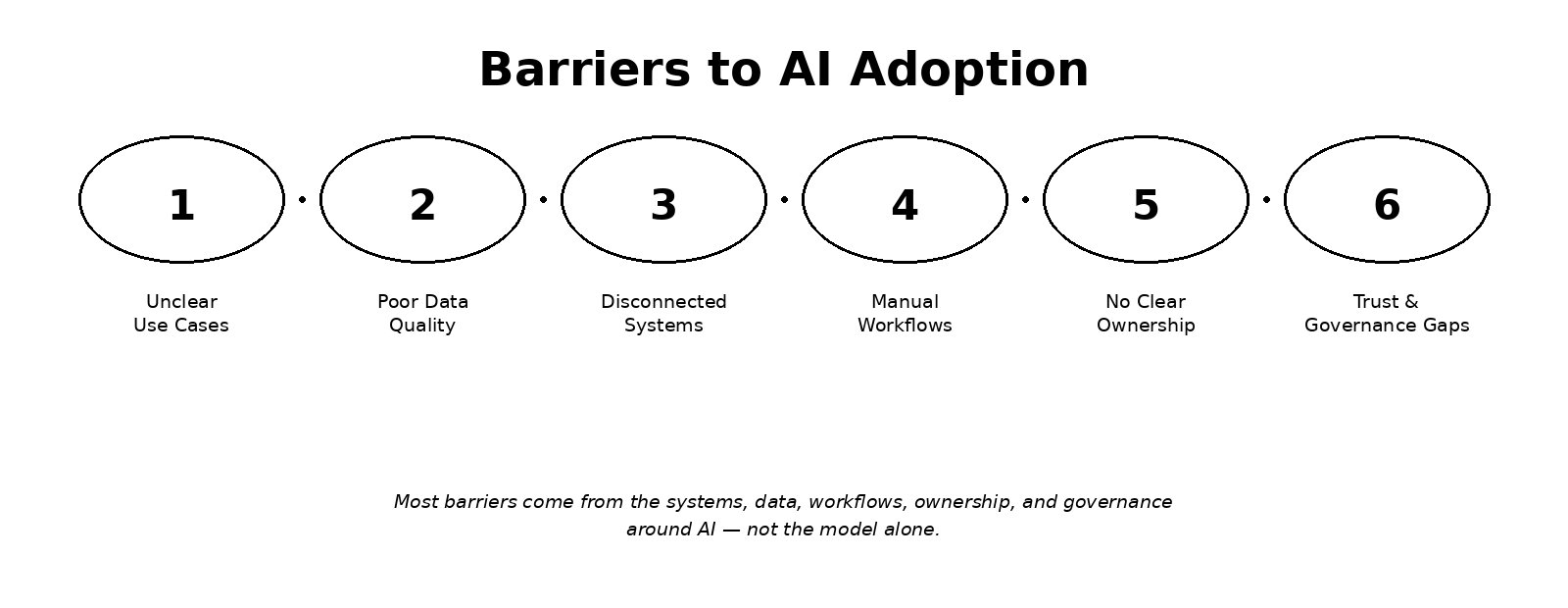
The barriers to AI adoption tend to repeat across industries. Different organizations use different platforms, but the underlying problems are often similar: unclear objectives, weak data, fragmented systems, inconsistent processes, missing ownership, and limited confidence in how AI should be used.
Unclear use cases
Starting with “we need AI” creates a technology search instead of a business initiative. A useful use case should identify the problem, the people affected, the information required, the desired outcome, and how success will be measured. Without that clarity, teams can spend time testing tools without proving business value.
Poor data quality and accessibility
AI can only work with the information it can reliably access. Duplicate records, incomplete fields, outdated documents, inconsistent naming, or unclear data ownership can weaken results. The issue is not simply having more data; it is knowing which data is trustworthy and appropriate for the intended task.
Disconnected systems
Many established companies run on a mix of ERP, CRM, spreadsheets, custom applications, shared drives, and industry-specific tools. When those systems do not exchange information cleanly, AI receives only part of the business context. Integration work may be required before a cross-functional AI use case can scale.
Manual and inconsistent workflows
A process that changes by person, department, or location is difficult to automate reliably. If approvals happen through email, key steps depend on individual memory, or exceptions are not documented, AI may introduce more confusion instead of less. Workflow clarity creates a stable process for AI to support.
Lack of ownership and accountability
AI initiatives often sit between business leadership, IT, operations, security, and data teams. If no one owns the business outcome, data quality, adoption, and ongoing performance, the project can stall after the pilot. Ownership should be defined before implementation begins.
Skills, trust, and governance gaps
Employees need to understand when AI is useful, when human review is required, and what information is appropriate to use. Governance also matters. The NIST AI Risk Management Framework emphasizes managing AI risks across design, deployment, and use rather than treating governance as a one-time policy exercise.
Why Data Quality Matters
Data quality is one of the strongest factors affecting whether AI outputs can be trusted. An AI system may still generate a confident answer when the underlying information is incomplete or inconsistent. That makes data problems especially important: bad inputs may not always produce an obvious error.
For example, a company using AI to support customer or order decisions may have account data in a CRM, pricing in an ERP, service history in another platform, and operational notes in spreadsheets. If customer identifiers, product names, or status fields are inconsistent, the AI may combine information incorrectly or miss important context.
Improving AI readiness does not require cleaning every record in the company before starting. A better approach is to begin with the target use case, identify the data it depends on, and evaluate quality, access, ownership, freshness, and permissions for those specific sources. This keeps the work tied to a business outcome instead of turning readiness into an open-ended data project. Where governed data and resilient foundations are part of the roadmap, database migration and modernization may be a practical next step.
Why Workflow Clarity Matters
AI works best when the process it is supporting is reasonably well understood. That does not mean every workflow must be perfectly standardized, but the organization should know the main inputs, decision points, outputs, exceptions, and people involved.
Consider an AI assistant designed to help with quoting. If one team calculates pricing in the ERP, another uses a spreadsheet, and special discounts depend on undocumented judgment, the AI has no reliable operating pattern to follow. Before automation, the company may need to map how the quote actually moves from request to approval.
Workflow clarity also makes measurement easier. When the current process is documented, leaders can compare before-and-after performance using meaningful measures such as cycle time, manual touches, error rates, response time, or rework. That turns AI adoption from a technology experiment into an operational improvement initiative.
Why Disconnected Systems Create Friction
Disconnected systems create friction because AI often needs information from more than one application to produce useful business context. A model connected only to the CRM may know what a customer requested, but not whether the product is available, whether an invoice is overdue, or whether a production delay affects the promised delivery date.
This problem is common in established businesses that have added software over many years. ERP, CRM, inventory, finance, production, project management, shared drives, and custom applications may all hold part of the truth. Employees compensate with exports, spreadsheets, copy-and-paste work, or manual checks between systems.
What disconnected systems cause
- AI responses may lack critical business context.
- Employees may still need to gather information manually before AI can help.
- Integration work appears late and increases project scope.
- Data permissions become harder to understand across several platforms.
- Different versions of the same information can produce inconsistent answers.
AI can expose these gaps quickly. Instead of assuming every legacy system must be replaced, companies should evaluate whether the required information can be accessed through APIs, integration layers, database connections, or targeted modernization. For a deeper look at how readiness is evaluated across systems, data, workflows, and governance, see the AI Readiness Assessment Guide.
How Companies Can Prepare Before Adoption
Companies do not need to become perfectly “AI-ready” before testing any idea. They do need enough clarity to choose a realistic use case and understand the dependencies around it. A practical preparation process keeps early AI work focused and reduces avoidable rework.
- 01
Define the business problem first
Identify the workflow, decision, or bottleneck that needs improvement. Describe the current pain, the expected outcome, and the metric that would show whether AI helped.
- 02
Review the data required for that use case
Map where the information lives, who owns it, how current it is, and whether access is appropriate. Fix the highest-impact quality gaps before connecting AI to production data.
- 03
Map the current workflow
Document the main steps, handoffs, approvals, and exceptions. This helps reveal whether the process needs simplification before AI is added.
- 04
Evaluate systems and integrations
Determine which applications the AI use case must read from or write to. Review APIs, connectors, custom interfaces, security boundaries, and any legacy constraints that could affect implementation.
- 05
Assign ownership
Name a business owner for the outcome and involve IT, data, security, and process owners as needed. Clear accountability helps the initiative move from pilot to operational use.
- 06
Start narrow, measure, then expand
Pilot one meaningful use case with defined success criteria. Evaluate quality, user adoption, risk, and business impact before adding more teams, data sources, or automation.
Microsoft’s AI readiness guidance similarly treats strategy, data, infrastructure, governance, and organizational readiness as connected considerations. The point is not to slow AI adoption. It is to make sure the first investment has a realistic path to value.
If these reviews reveal gaps across systems, data, integrations, or workflows, an AI Readiness Assessment can help leadership decide what should be fixed first and which AI opportunities are realistic now. For a practical plan that sequences these steps, see the AI Adoption Strategy Guide.
Common questions about AI adoption
No. Most companies will never have perfect data across every system. The better standard is whether the data needed for a specific AI use case is accurate enough, accessible, current, appropriately governed, and understood well enough to support the decision or workflow. Start with the use case, then improve the data that matters to it.
Related insights
View all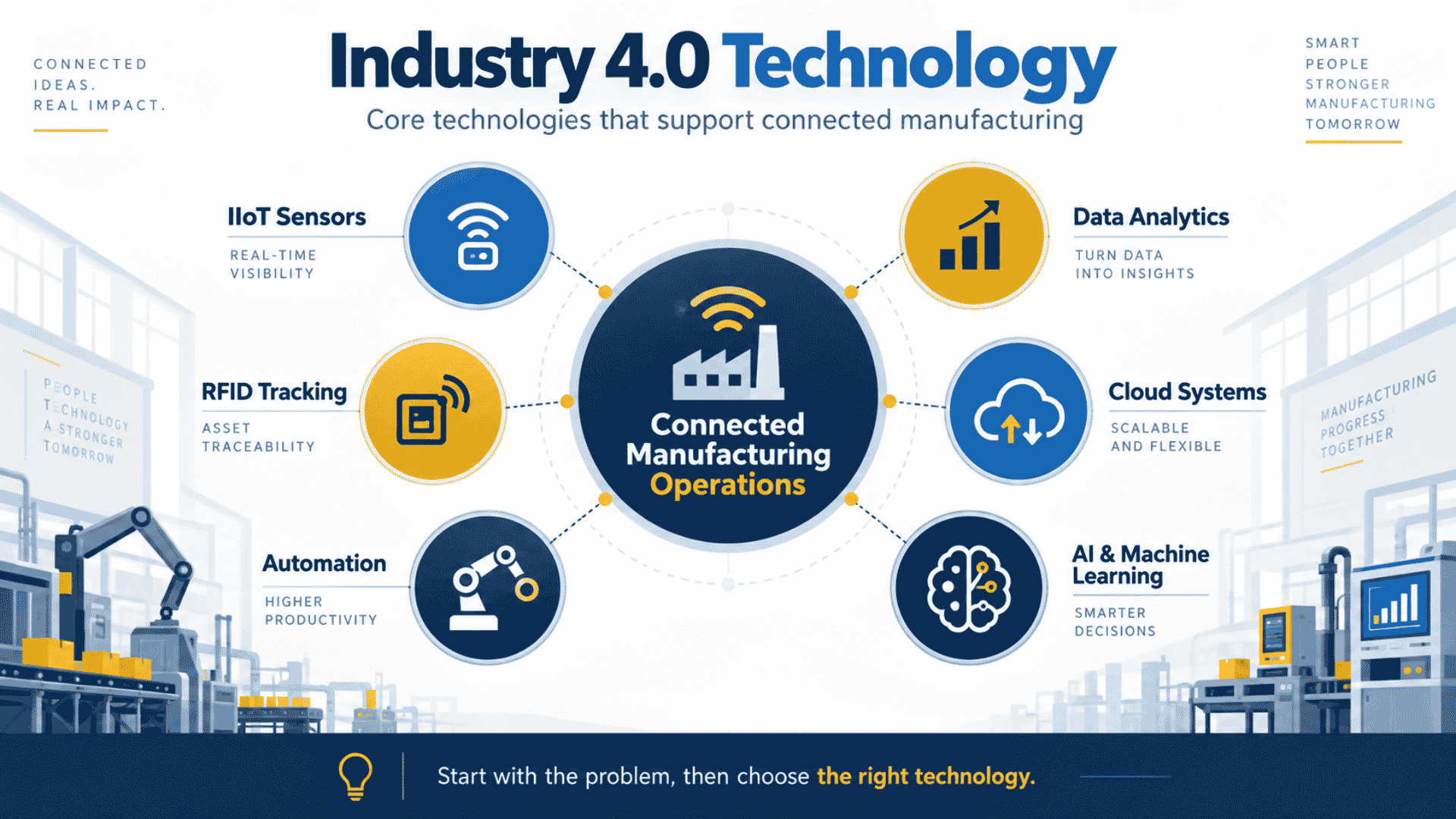
Industry 4.0 Technology: What It Means for Manufacturers in 2026
Industry 4.0 technology connects equipment, software, data, and business systems so manufacturers can improve how work moves through the ope...
Read article
How Letter B Helps MSP's Deliver Digital Transformation
MSP digital transformation is becoming essential as manufacturing clients demand more than infrastructure and support. At Letter B Global Te...
Read article
Where Modern Manufacturing Technology Replaces Legacy Systems in Manufacturing in 2026
Modern manufacturing technology does not require replacing everything at once. Many improvements focus on the areas where inefficiencies hav...
Read article