
What is AI readiness in business?
AI readiness describes how prepared a business is to adopt, integrate, manage, and scale AI in day-to-day operations. An organization may already be experimenting with generative AI tools, automation platforms, or embedded AI features. However, using an AI tool does not automatically make the organization AI-ready.
True readiness means the business can connect AI to real workflows, provide it with reliable information, manage access appropriately, evaluate its outputs, and measure whether it improves the business. Readiness spans business strategy and goals, use cases, data quality and governance, technology and infrastructure, business systems and integrations, people and skills, security and risk, and measurement and oversight.
In simple terms, an AI-ready business knows which problems it wants AI to solve. It also has the data, systems, processes, people, and guardrails needed to support those solutions.
Consider a manufacturer that wants to use AI to improve quoting. Before introducing AI, the company needs to understand where pricing data is stored, how material costs are calculated, which employees review estimates, how approvals work, and whether its quoting, inventory, and ERP systems can share information. Without that foundation, AI may only add another disconnected tool to an already fragmented process.
Why AI readiness matters before you invest
AI tools are becoming easier to access, but successful adoption still requires preparation. When organizations rush into AI without evaluating their current environment, they may encounter inconsistent outputs, security concerns, integration problems, employee resistance, or pilots that never become part of normal operations.
AI readiness matters because it influences whether a business can:
- Connect AI investments to measurable goals
- Select realistic and valuable use cases
- Give AI access to trustworthy information
- Integrate AI into existing workflows
- Protect sensitive business and customer data
- Manage regulatory and operational risks
- Move beyond isolated experiments
- Measure productivity, efficiency, quality, or revenue impact
AI does not automatically repair disconnected systems or unclear processes. In many cases, it makes those existing problems more visible.
What makes a business ready — or not ready — for AI?
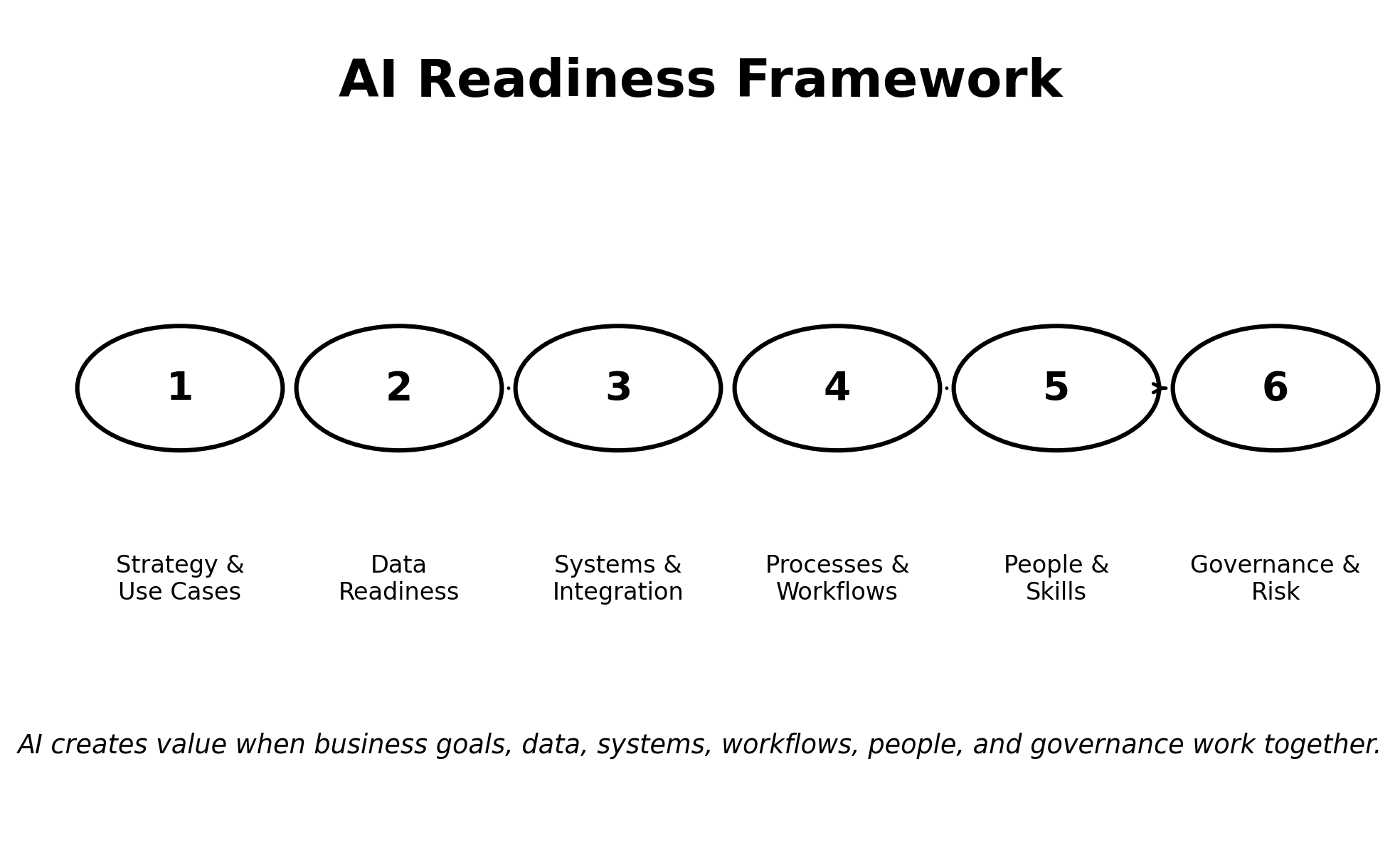
AI readiness is not a simple yes-or-no condition. A business may be well prepared in one area and significantly behind in another. Leaders can evaluate readiness by looking for positive, cautionary, and high-risk indicators across six dimensions.
Business goals & AI use cases
- Reducing the time required to prepare quotes
- Improving access to technical or operational information
- Automating repetitive data entry
- Identifying inventory exceptions earlier
- Summarizing service, sales, or project activity
- Helping employees find answers across internal documents
Data quality & governance
- Important operational information is stored digitally
- Employees generally trust the data they use
- Duplicate, incomplete, and conflicting records are manageable
- Access permissions reflect employee responsibilities
- Data retention and privacy expectations are documented
Technology & AI-ready business systems
- Accessible and well-structured data
- APIs, connectors, or integration options
- Consistent identity and access controls
- Reliable security and backup practices
- Enough performance and scalability for the intended use case
Processes & workflows
- Important workflows are documented or can be clearly explained
- Process owners understand where delays and errors occur
- Teams can distinguish rules-based tasks from judgment-based decisions
- The process has measurable indicators such as time, cost, or error rate
People, skills & culture
- Leaders explain the business reason for using AI
- Employees are involved in identifying practical use cases
- Teams receive training relevant to their roles
- Employees are encouraged to validate AI-generated outputs
- Change management is included in the implementation plan
Governance, security, risk & compliance
- The business has baseline cybersecurity controls
- Employees understand which data is sensitive
- Access is based on roles and business needs
- The organization has written guidelines for responsible AI use
- Relevant regulatory and contractual requirements are understood
Common signs of poor AI readiness
Organizations often discover readiness problems only after an AI project has started. The following warning signs may indicate that a business needs to improve its foundations before expanding AI adoption.
AI projects stall after the pilot stage
The organization can demonstrate a proof of concept, but cannot connect it to production systems, real workflows, or dependable data.
No one owns AI
There is no accountable executive sponsor, process owner, technical owner, or cross-functional team.
Data becomes the main bottleneck
Project teams spend significant time locating data, correcting records, negotiating access, or combining information from different systems.
Core systems cannot exchange information
AI outputs remain separate from the systems employees use every day, creating additional copying, re-entry, or manual steps.
Shadow AI use is growing
Employees are already using public or unapproved tools because no official guidance or supported alternative exists.
Compliance and security are considered too late
Risks are identified after technology has been selected or after employees have started using it.
The workflow is not clearly understood
Teams want to automate a process, but cannot agree on how it currently works, who owns it, or what the output should be.
There is no way to measure impact
The project is described as innovative, but no baseline, target, or business metric has been defined.
Experiencing one of these challenges does not mean a company should avoid AI. It means the business should address the relevant gaps before increasing its investment.
Why systems and data matter so much
Business leaders often focus first on AI models, copilots, agents, and chatbots. However, the usefulness of these tools depends heavily on the systems and information underneath them.
AI cannot reliably support a process when:
- Required data cannot be found
- Different systems contain conflicting information
- Access permissions are unclear
- The workflow depends on undocumented manual steps
- A legacy application cannot exchange data
- Employees do not trust existing reports
- Important information is stored in emails or personal files
This is why AI readiness frequently overlaps with system integration, legacy modernization, workflow improvement, and data management.
What are AI-ready business systems?
AI-ready business systems are designed or prepared to make reliable information available to AI-enabled workflows. They generally store data in structured and accessible formats, support APIs or secure data exchange, maintain clear identity and permission controls, and integrate with other operational platforms.
A system does not need to be new to be AI-ready. An older or custom-built application may still support AI if its data is usable and a practical integration method is available. The key question is whether the system can participate reliably and securely in the intended workflow.
Letter B's custom software development and legacy application modernization services are relevant when existing systems cannot support the data flow or integrations an AI use case requires.
What is AI-ready data?
Quality
The information is sufficiently accurate, complete, current, and consistent for the intended task. The required quality depends on the use case — drafting an internal summary may tolerate minor gaps, while supporting a financial, production, or customer-facing decision may require much stricter controls.
Accessibility
Authorized employees and systems can locate and use the information without excessive manual effort. Accessibility does not mean everyone should have access — it means the correct information is available to the correct people and tools when needed.
Governance
The organization has rules for ownership, permissions, privacy, retention, and acceptable use. Without these qualities, AI may produce unreliable responses, use outdated information, reveal data to the wrong users, or create results that employees do not trust.
What an AI readiness framework usually includes
An AI readiness framework provides a structured way to evaluate whether the organization can support practical AI use. Different frameworks may use different labels, but most examine similar business capabilities.
| AI readiness area | What it evaluates | Question business leaders should ask |
|---|---|---|
| Strategy and use cases | Business goals, priorities, value, and success measures | What measurable problem should AI help us solve? |
| Data readiness | Quality, accessibility, ownership, and governance | Is the required information accurate, available, and trusted? |
| Technology and infrastructure | Platforms, performance, security, and integration capabilities | Can our current environment support the intended AI use case? |
| Business systems | ERP, CRM, databases, custom applications, and system connections | Can the systems involved exchange information reliably? |
| Processes and workflows | Steps, decisions, handoffs, exceptions, and ownership | Is the process understood well enough to improve or automate? |
| People and skills | Leadership support, training, roles, and change readiness | Who will use, manage, and validate the AI-supported process? |
| Governance and risk | Privacy, security, compliance, acceptable use, and oversight | What can the AI access, and how will its outputs be reviewed? |
| Operations and measurement | Deployment, monitoring, maintenance, and business impact | How will we know whether the AI initiative is working? |
Using an AI readiness framework helps leaders avoid evaluating only one part of the organization. Readiness depends on how these areas work together.
What is an AI readiness assessment?
An AI readiness assessment is a structured review of the organization's ability to adopt and scale AI. It helps leaders understand where the business is prepared, where gaps exist, and which actions should be prioritized before major investments are made.
An assessment may include:
- Leadership and employee interviews
- Business process reviews
- System and application mapping
- Data source identification
- Integration analysis
- Security and access reviews
- Governance and policy questions
- Use-case identification
- Readiness scoring
- Prioritized recommendations
- A phased roadmap
The goal is not to judge whether a company is simply ready or unready. The goal is to determine which AI opportunities are practical now, which require preparation, what dependencies could create risk or delays, and what the business should do first.
When to consider an AI readiness assessment
Before a major AI investment
Identify whether the organization has the data, systems, ownership, and governance required to support the proposed initiative.
After early AI experiments
Validate integration, security, scalability, and employee adoption before scaling promising pilots.
When AI use is spreading informally
Establish policies, approved use cases, and safer practices if employees are using multiple AI tools without guidance.
During strategic planning or budgeting
Prioritize system modernization, data improvements, training, integration, and governance investments.
When legacy systems limit initiatives
Determine whether existing applications can support AI through integration, modernization, or process redesign.
When operations depend on manual work
Understand the workflow before selecting a solution for repeated data entry, spreadsheets, or email-driven approvals.
During mergers or system changes
Account for changes to systems, ownership, permissions, processes, and data that affect AI readiness.
How business leaders can improve AI readiness
Improving AI readiness does not require transforming the entire organization at once. The most practical approach is to begin with a small number of business priorities and evaluate the systems, data, people, and controls connected to them.
- 01
Define two or three priority business outcomes
Select problems that are important, recurring, and measurable. Avoid beginning with a tool. Begin with the outcome.
- 02
Map the current workflow
Document how the work happens today, including the people, systems, information, manual steps, approvals, exceptions, delays, and errors involved.
- 03
Identify the required data
Determine what information the AI use case would need and where that data currently lives, and whether it is complete, current, trusted, owned, and accessible.
- 04
Review the system landscape
Create a clear view of the applications involved, paying attention to legacy software, custom applications, ERP and CRM platforms, and available APIs or connectors.
- 05
Establish clear ownership
Assign responsibility for the business outcome, the process, the technology, and the ongoing use of AI across leadership, operations, IT, data, and security.
- 06
Create practical AI usage guidelines
Initial guidelines can address approved tools, restricted data, review requirements, customer or employee information, and escalation requirements.
- 07
Start with a manageable use case
Choose a use case that is valuable enough to matter but focused enough to evaluate before attempting a broader deployment.
- 08
Measure the result
Establish a baseline before implementation and track time required, manual steps, error rate, adoption, response time, throughput, cost, quality, or risk.
Moving from AI interest to AI readiness
For many established and mid-sized businesses, the greatest AI opportunity is not simply adding a chatbot to the organization. It is identifying where employees lose time, where information becomes difficult to find, where systems fail to communicate, and where better decisions depend on disconnected data.
Letter B approaches AI readiness from this operational perspective. Before recommending technology, the focus is on understanding workflows, systems, data, and the business problem that needs to be solved. Not every process needs AI. In some cases, integration, automation, or modernization may be the more practical first step.
Explore Letter B's industry solutions to see how tailored software and connected systems can address operational challenges across manufacturing and other complex environments.
A business does not become AI-ready by purchasing an AI product. It becomes AI-ready when its goals, workflows, data, systems, people, and governance are dependable enough for AI to support real work.
Common questions about AI readiness
AI readiness is how prepared your organization is to use AI effectively, safely, and consistently. It looks at whether the business has clear goals, reliable data, connected systems, understood workflows, trained employees, and appropriate governance. An AI-ready organization does not simply have access to AI tools. It has the operational and technical foundation needed to connect those tools to real business problems.