
What is AI readiness, and what does an AI readiness assessment evaluate?
AI readiness is a business's ability to adopt and scale AI with the right strategy, data, systems, security, governance, ownership, and operating practices in place. It is not a single technology milestone. Readiness depends on whether the conditions around a specific AI use case are strong enough to support reliable, responsible results.
An AI readiness assessment is a structured review of those conditions. It looks at what is working, where the gaps are, and what should happen before the organization invests further in AI tools, automation, copilots, agents, or custom AI applications.
There is no single universal AI readiness framework. Microsoft's AI Readiness Assessment evaluates seven areas, including business strategy, AI governance and security, data foundations, organization and culture, infrastructure, and model management. Cisco's AI Readiness Index uses six pillars: strategy, infrastructure, data, governance, talent, and culture. The labels vary, but the practical lesson is consistent: AI readiness crosses business and technology boundaries.
A practical definition for business leaders: AI readiness means knowing what problem you want AI to solve, whether the required information and systems can support that use case, how risk will be managed, who owns the outcome, and what needs to change before the solution can scale.
Why assess AI readiness before investing in AI?
Many organizations start with the tool: a new AI platform, a vendor demo, an employee pilot, or a request to "add AI" to an existing process. That can create momentum, but it can also expose problems that were already present in the business: unclear workflows, inconsistent data, disconnected systems, poor permissions, or no shared definition of success.
A readiness review changes the order of the conversation. Instead of asking, "Which AI tool should we buy?" leadership starts with, "Which business problem is worth solving, and what foundation does that use case require?"
A readiness review helps the business:
- Reduce avoidable rework by identifying system, data, governance, and process gaps before they become implementation blockers.
- Prioritize higher-value use cases that have a clear business owner, usable information, and measurable outcomes.
- Make investment decisions in sequence by separating what can be piloted now from modernization work that should happen first.
- Create cross-functional alignment across business, operations, IT, data owners, and leadership.
- Set realistic expectations about what AI should and should not do before users begin relying on it.
The assessment also helps leadership separate "AI work" from the foundational work AI exposes. If a workflow depends on duplicate customer records, an unsupported legacy database, or approvals that only exist in email, the right next step may be data cleanup, integration, or process redesign before model selection.
Five areas an AI readiness assessment should review
A practical AI readiness checklist for a mid-sized business should cover five connected areas. A weakness in one area can limit the value of the others, so the assessment should look at the full operating picture rather than score each item in isolation.
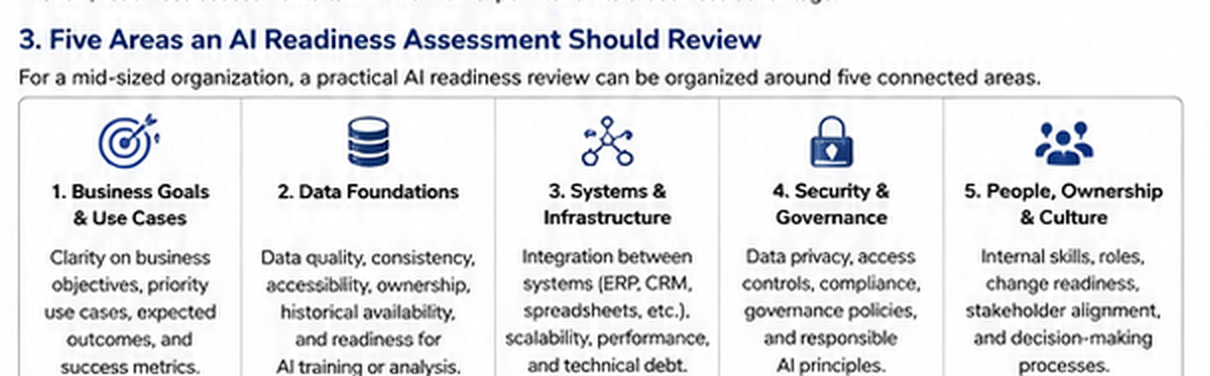
Business goals and use cases
The assessment should begin with the business problem, not the model. AI projects are easier to evaluate when leaders can explain where work is slow, inconsistent, expensive, difficult to scale, or dependent on employees manually gathering information from several places.
- The business problem or workflow the organization wants to improve.
- Who is affected by the current process and who owns the outcome.
- What information the AI use case needs to access.
- What success would look like in operational or business terms.
- Whether the use case is suitable for AI, automation, integration, process redesign, or another approach.
Data foundations
AI systems depend on information that is accurate enough, accessible enough, and well governed enough for the intended use. A readiness review should look beyond whether data exists and ask whether it can be trusted and used appropriately.
- Where important operational and customer data lives.
- Whether records are complete, current, consistent, and duplicated across systems.
- Whether the organization knows which system is the trusted source for critical fields.
- How data is classified, accessed, retained, and governed.
- Whether documents, transactions, and records are structured in ways that support the proposed AI use case.
Systems, integration, and infrastructure
For AI to improve a workflow, it often needs to connect with the systems where work already happens — ERP, CRM, accounting, inventory, quoting, support, document management, or custom line-of-business applications.
- Which systems participate in the workflow.
- Whether APIs, connectors, exports, middleware, or other integration methods exist.
- Whether legacy applications can exchange data reliably with newer platforms.
- Whether test or sandbox environments are available for controlled pilots.
- Whether performance, reliability, and technical debt could limit a future AI solution.
Security, governance, and responsible use
Security and governance should be designed into AI adoption from the beginning. An assessment should review who can access information, what data an AI system is allowed to use, where outputs may require human review, and how the organization will manage approved AI use.
- Identity and access controls for the systems and data involved.
- Data privacy and confidentiality requirements.
- Approved tools, vendors, and AI use policies.
- Human review requirements for high-impact decisions or sensitive outputs.
- Logging, auditability, monitoring, and escalation paths.
- Ownership for ongoing AI risk decisions.
People, ownership, and change readiness
AI adoption is also an operating-model change. Even technically sound solutions can fail if employees do not understand when to use them, business owners are not accountable for outcomes, or the company has no process for feedback and improvement.
- Executive sponsorship and business ownership.
- The employees and subject-matter experts who understand the workflow.
- Internal IT, data, security, and operations capacity.
- Training needs and expectations for responsible AI use.
- How feedback, exceptions, and errors will be handled after launch.
Common AI readiness gaps in mid-sized businesses
Mid-sized businesses often have enough process complexity to benefit from AI, but they may have built that complexity gradually through years of ERP changes, spreadsheets, departmental tools, custom applications, acquisitions, or practical workarounds. That creates a predictable set of readiness gaps.
These gaps are not unique to AI. In many cases, AI simply makes existing operational weaknesses more visible because it depends on information moving consistently across processes and systems. The purpose of the assessment is to determine which gaps materially affect the first use case and which can be addressed later as part of a broader modernization roadmap.
How disconnected systems limit AI readiness
Disconnected systems are one of the most important readiness issues because AI needs relevant context. When a process spans multiple applications that do not communicate, information becomes partial, delayed, or dependent on employees manually assembling the full picture.
Consider a customer-service use case. Support history may live in a ticketing platform, contract terms in a document repository, invoice details in finance software, project status in a delivery tool, and customer notes in CRM. An AI assistant cannot provide a dependable view simply because each system contains useful data. The organization must determine what information is needed, how it can be accessed, and whether the access is appropriate for that user and use case.
What disconnected systems cause
- AI responses may lack critical business context.
- Employees may still need to gather information manually before AI can help.
- Integration work appears late and increases project scope.
- Data permissions become harder to understand across several platforms.
- Different versions of the same information can produce inconsistent answers.
A readiness assessment should produce a simple integration map for the proposed use case — the systems involved, the information each contributes, the direction and frequency of data movement, the owner, the access method, and any known reliability concerns. Not every source needs to be connected on day one; a focused pilot may intentionally use a smaller set of trusted systems.
How poor data quality affects AI results
AI is only as useful as the information available to the use case. Poor data quality does not always cause a system to fail visibly; it can produce answers that look plausible but are incomplete, inconsistent, or based on outdated records. That makes data quality a business trust issue, not only a technical issue.
Common data quality problems include:
- Duplicate customer or product records.
- Missing or inconsistent fields.
- Different names or definitions for the same metric.
- Old documents that remain searchable after policies or processes change.
- Critical information stored in spreadsheets, inboxes, or employee-maintained files.
- No clear owner for correcting source data.
A readiness assessment should therefore ask whether the data is fit for the intended use — not whether it is "perfect." A narrow pilot may only require a defined set of clean, governed information, while a broad enterprise assistant may require substantially more work. The review should also define how output quality will be checked using known-good examples, subject-matter expert review, or comparison against existing reports.
If important data is trapped in aging databases or difficult-to-manage environments, database modernization and migration may be part of the readiness roadmap rather than an AI task by itself.
What an AI readiness report should include
An AI readiness assessment tool can help standardize questions and scoring, but the questionnaire is not the deliverable. The value comes from turning findings into decisions: what can move forward, what should be fixed first, and which use case offers the best balance of business value, feasibility, data availability, and risk.
| Report element | What it should show |
|---|---|
| Current-state summary | A clear view of readiness across business goals, data, systems, governance, and people. |
| Strengths and readiness advantages | Capabilities the organization can use now, such as strong data ownership, stable integrations, or an already-defined use case. |
| Gap analysis | Specific issues that could limit reliability, security, adoption, or scale. |
| Use-case prioritization | Which AI opportunities fit current capabilities and which require preparation first. |
| Data and integration findings | Where required information lives, whether it is usable, and how systems can connect. |
| Security and governance findings | Access, privacy, policy, oversight, and risk-management considerations for proposed use cases. |
| Recommended first use case | A practical starting point based on value, feasibility, data readiness, and risk. |
| Prioritized roadmap | Recommended next steps sequenced by urgency, dependency, effort, and business impact. |
| Required investments | People, process, software, integration, data, or modernization work needed to support the roadmap. |
A strong report should be specific enough that leadership can decide what to fund, what to delay, who needs to own each action, and what evidence will show that the first AI initiative is working.
When to book an AI readiness assessment
The best time to assess readiness is before major AI spending or a broad rollout — when leadership sees practical potential but still has the flexibility to improve the foundation and sequence investments correctly. Readiness work is also useful after a successful experiment and before a broader rollout.
A readiness assessment is worth considering when:
- Leadership wants to introduce AI into operations, customer service, sales, finance, delivery, or internal productivity.
- Teams are already using AI tools without a shared policy, roadmap, or ownership model.
- The company is modernizing applications, integrations, databases, or workflows and wants those investments to support future AI use.
- Disconnected systems or inconsistent reporting are limiting automation and decision-making.
- Security, privacy, or risk concerns are preventing stakeholders from approving AI initiatives.
- The organization needs to compare several AI ideas and decide which one should be first.
A business does not need to modernize everything before it can begin. The goal is to understand the dependencies around the first useful AI opportunity and create a phased path from readiness work to implementation. Organizations should also revisit readiness when the environment changes materially — for example, after replacing an ERP or CRM platform, consolidating systems, acquiring another company, or moving an AI capability into a new business process.
Readiness is not a permanent certification. It changes as the business, systems, risks, and use cases change.
Common questions about AI readiness
The right duration depends on the number of use cases, systems, business functions, and stakeholders being reviewed. A focused assessment around one workflow may require only a small set of interviews, system reviews, and working sessions, while a broader assessment that spans several departments, data sources, and legacy applications can reasonably take multiple weeks. The final recommendation should be based on evidence from the actual workflow, systems, data, and people involved.