
Say "manufacturing automation" in a room of plant managers and most people picture the same thing. Robot arms. A new production line. Six figures of capital equipment and a shutdown while it gets installed.
For most small and mid-sized manufacturers, that's not where automation actually starts. It starts with a spreadsheet that one person updates every morning. An inventory count that's accurate on Monday and questionable by Thursday. Two systems that both hold the right information and have no idea the other exists.
None of these look like a crisis. They cost you anyway, in time, in errors, and in how long it takes to answer a straightforward question about your own operation.
So the first move isn't choosing technology. It's finding the work that's repetitive, slow, hard to track or quietly causing problems, and then asking where automation would make that work easier and more reliable.
Iowa manufacturers: grants of up to $75,000 are available through the Manufacturing 4.0 Technology Investment Program, and the CIRAS assessment you need before applying must be requested by November 20, 2026. More on that below, or see our Iowa Manufacturing 4.0 funding guide.
What does manufacturing automation include?
Manufacturing automation is any use of technology that reduces manual work and improves how a process runs. It can be physical equipment, software, connected systems, or a mix of all three:
- Robots and automated equipment
- Sensors and connected machines (IIoT)
- Barcode and RFID tracking
- Inventory automation and reorder alerts
- Automated production data collection
- System and API integration
- Scheduling and approval workflows
- Dashboards and real-time reporting
- Data moving automatically between systems
That last group matters more than most manufacturers expect. We regularly see shops with genuinely modern equipment on the floor that still run inventory on a spreadsheet, send production updates by email, and rebuild the same report by hand every Monday morning.
In that situation, the next automation opportunity isn't another machine. It's the flow of information between the machines, the office, and the people who need to make decisions. That's usually cheaper, faster to implement, and easier to measure than a capital purchase.
Which manufacturing processes are worth automating?
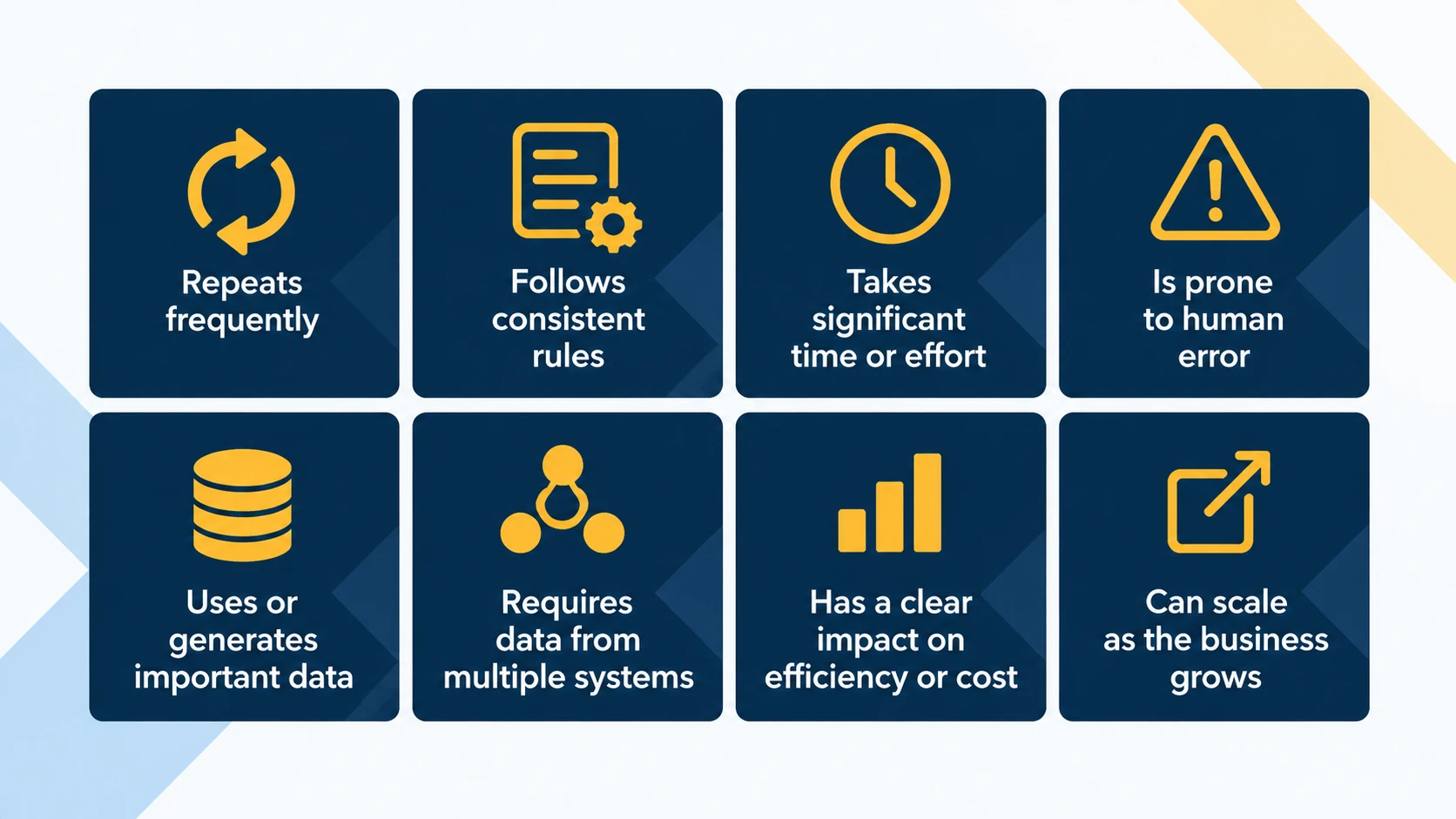
Not every process should be automated. The best candidates happen often and follow similar steps each time. Look for work that is:
- Repetitive
- Time-consuming
- Easy to delay when the floor gets busy
- Prone to manual errors
- Based on clear rules
- Dependent on data entry
- Spread across several systems
- Hard for managers to see into
Here's the arithmetic that convinces most people. Someone copies order details from one system into another. It takes four minutes, and nobody thinks about it. At 40 orders a day, that's over two and a half hours daily, around 650 hours a year, on retyping information you already have. The same math applies to manual inventory updates, production reporting, purchase approvals, material checks, and shipping paperwork.
The question worth asking on a walk-through of your own operation: where are people spending time moving information instead of using it? That's almost always where the first automation project is hiding.
Which manual manufacturing workflows can be automated?
Manual work isn't a problem in itself. It becomes one when the same task repeats, day after day, with no variation and no judgment involved. Some of the most common examples we see on Iowa shop floors:
| Manual workflow | Possible automation |
|---|---|
| Updating inventory in spreadsheets | Barcode or RFID-based inventory updates |
| Entering the same order into several systems | Automatic data transfer between systems via API integration |
| Checking production status by walking the floor | Real-time production tracking |
| Building reports by hand | Automated dashboards and scheduled reports |
| Chasing approvals over email | Digital approval workflows |
| Checking material levels manually | Inventory alerts and reorder notifications |
| Recording shop floor data on paper | Digital data collection at the point of work |
| Rekeying information between systems | System and ERP integration |
The goal isn't to remove people from the process. It's to remove the part of the process that doesn't need a person. When your team stops copying data, double-checking the same numbers and updating three systems with one piece of information, that time goes back into work that actually needs their experience.
Why system integration matters more than another tool
Most manufacturers we talk to don't have a technology shortage. They have an ERP, inventory software, spreadsheets, production tools, shipping software, and maybe a custom application or two. The problem is that none of it talks to anything else.
A disconnected order process usually looks something like this. The order arrives in one system. Someone retypes it into the ERP. Someone else updates a spreadsheet. Production finds out by email. Inventory is adjusted separately. At the end of the week, a manager pulls numbers from four places to build a report that's already out of date.
Every handoff in that chain is a chance for a delay, a typo or a version of the truth that doesn't match the others. A connected process moves the same information with far less effort:
Customer order → ERP → production → inventory → shipping → reporting
This is why system and API integration is one of the highest-value forms of manufacturing automation, and why it's worth asking a question before buying anything new: can the systems we already own work better together? Connecting what you have often delivers more than adding a tenth application, and it doesn't ask your team to learn another interface.
We built exactly this kind of integration layer for an MSP client to automate vendor syncing and manual verification loops, which cut weeks off their delivery timeline. You can read the OnPart case study for the details.
How automation improves inventory and tracking
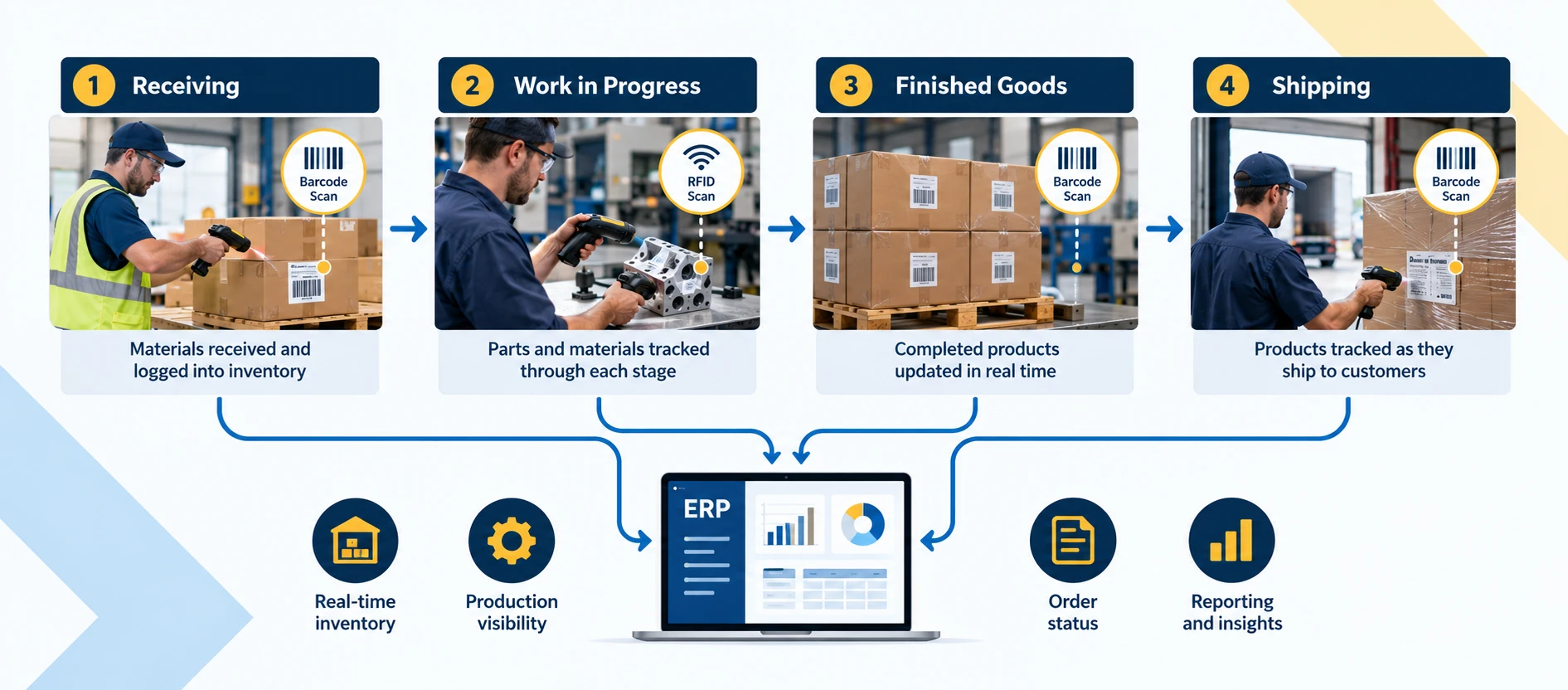
Inventory is where manual process pain shows up first, because it quietly makes simple questions hard to answer. How much material do we have? Where is it? What's already been consumed? Which items are ready to ship? Do the system records match the floor? Do we need to reorder?
If the answer to any of those is "let me check the spreadsheet and call you back," there's an automation case to be made.
Barcode and RFID systems capture that information as items move, rather than relying on someone to record it later. Materials, parts, work in progress, tooling, and finished goods can all be tracked at the point where they move, and that data can flow straight into your inventory or ERP system. For many of the manufacturers we work with, inventory and RFID tracking is the most practical first step toward a genuinely connected operation, because it produces visible results in weeks and creates the data foundation everything else depends on.
The most common manufacturing automation mistakes
Automation works when it solves a clearly defined business problem. Most of the failures we see start when the technology becomes the point.
Automating a bad process. If a workflow is already confusing, automating it just makes the confusion happen faster, and now it's encoded in software. Map the process, cut the unnecessary steps, then automate what's left.
Trying to do everything at once. A big program looks impressive in a board deck and carries proportionally more risk. A narrow project with one clear goal is easier to deliver, easier to measure and much easier to get your team behind.
Ignoring the systems you already run. A new tool that doesn't connect to your ERP becomes another island, and islands create manual work rather than removing it. Integration belongs in the requirements, not the phase-two wish list.
Leaving the operators out. The people doing the work know exactly where the workflow breaks, which workarounds exist, and why. They'll also decide whether the new system gets used properly. Involve them before the design is finished, not during training.
Not defining what success looks like. Decide upfront what you're measuring: hours of manual data entry removed, error rate, order processing time, inventory accuracy, time to produce a report. If you can't compare before and after, you can't tell whether the project worked, and you'll struggle to justify the next one.
How to prioritize your first automation project
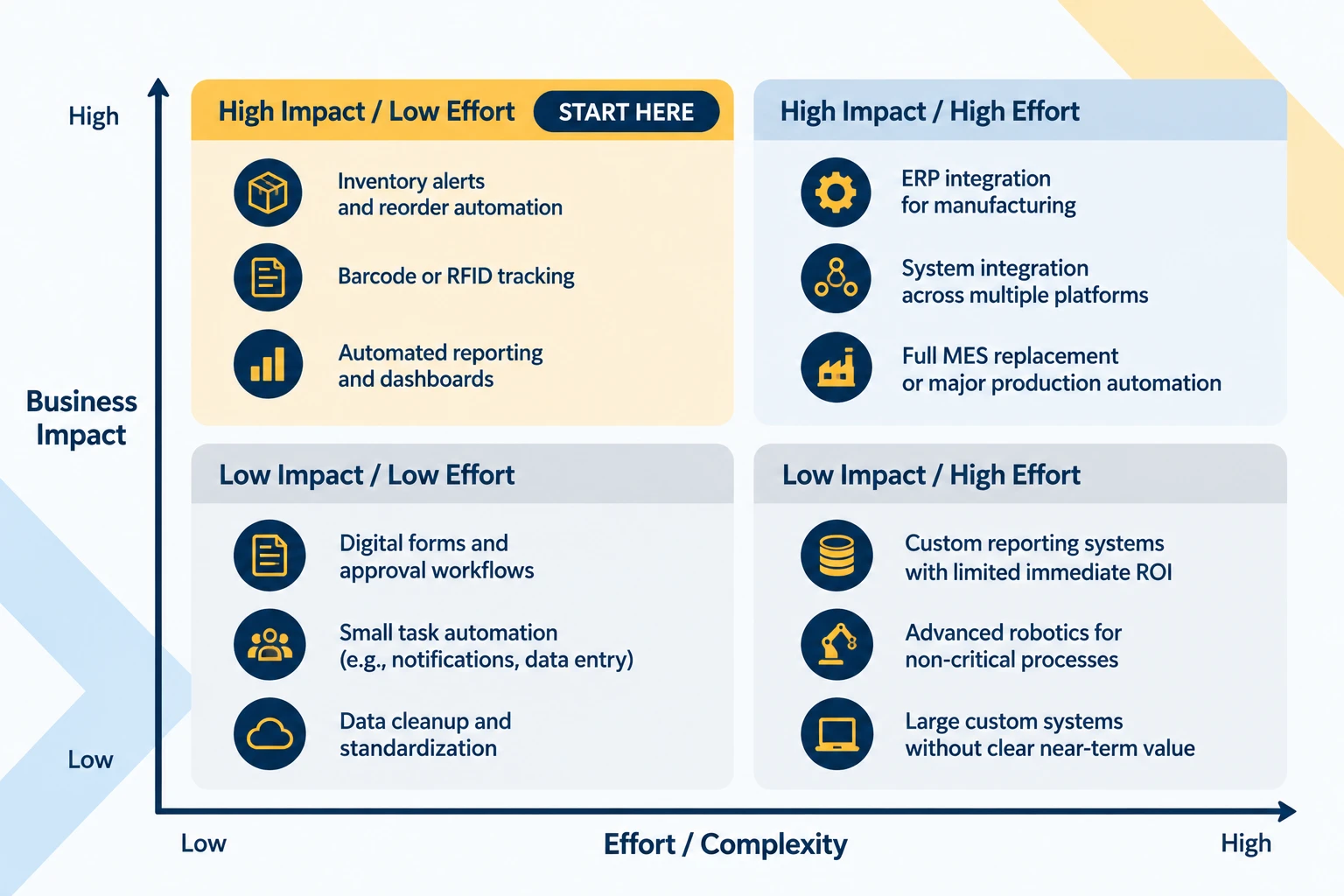
Most manufacturers have several processes worth improving. The hard part is choosing. Six questions usually settle it:
- How much time does it consume? A daily task is worth more than a monthly one, even if the monthly one feels more painful.
- How often does it cause errors or delays? Frequent, visible problems make the strongest business case and the easiest before-and-after comparison.
- Does it affect other parts of the business? A slow inventory process reaches purchasing, production, shipping and customer service. Fixing it pays in several places.
- Would better visibility help as much as speed? Sometimes knowing what's happening right now is worth more than doing it faster.
- Can you measure the result? If there's no number attached, pick something else first.
- Will it work with your current systems? Integration should be part of the plan from day one, not a surprise in week six.
A good first project doesn't have to be the biggest one. It needs to solve a real problem, show measurable value within a reasonable timeframe, and leave behind a foundation the next project can build on. In practice, that's often a single integration or a tracking workflow delivered in weeks rather than quarters.
If AI is part of the conversation too, the same logic applies, and the groundwork matters more. Our AI readiness assessment looks at whether your data, systems, and workflows can actually support it before anyone spends money.
What funding is available for Iowa manufacturers?
Iowa manufacturers planning an automation or Industry 4.0 investment may be able to offset part of the cost. The Manufacturing 4.0 Technology Investment Program, run by the Iowa Economic Development Authority, supports small and mid-sized manufacturers adopting or integrating smart technologies into existing operations.
The essentials:
- Up to $75,000 over the lifetime of the business, with a 1:1 cash match required.
- An Industry 4.0 assessment from CIRAS at Iowa State is required before you apply and must be submitted with the application.
- The last day to request that assessment is November 20, 2026. The assessment window opened on September 8.
- Eligibility covers manufacturers incorporated or authorized to do business in Iowa with NAICS codes 31-33 that are in good standing with the Iowa Department of Revenue. Applicants must employ at least 3 and fewer than 125 full-time employees across all locations, derive at least 51% of revenue from manufactured goods, and have operated for at least three years.
Eligible technology typically includes automation equipment, robotics, sensors, IIoT infrastructure, predictive maintenance tools, data analytics and visualization, cybersecurity software, and RFID and inventory tracking technology. You can request the CIRAS assessment here, and applications are submitted through iowagrants.gov.
Funding shouldn't be the reason to automate. But if you already have an operational problem and a practical project in mind, this can make the investment considerably easier to approve. Our Iowa Manufacturing 4.0 funding page walks through eligibility, timing and what makes a strong application.
Start with the process you want to improve
Manufacturing automation doesn't have to begin with a factory transformation. It usually begins with one problem: a manual inventory count, a report that takes half a day, two systems that should share data and don't, a production workflow nobody can see into until it's finished.
Pick the one that's costing you most, make it measurably better, and build from there. That's a far more reliable path than a program that tries to fix everything at once.
Looking at automation, integration or inventory tracking?
Letter B has built practical software for manufacturers since 2008: custom applications, ERP and API integration, RFID and inventory tracking, cloud systems and legacy modernization. We work with what you already have rather than asking you to replace it, and we design around your workflow instead of the other way around.
Book a strategy call and we'll look at the process you want to improve and what it would take to automate it. If you're in Iowa and considering a Manufacturing 4.0 project, it's worth doing before the November 20 assessment deadline.
Related: Manufacturing solutions · Iowa Manufacturing 4.0 funding · Modernizing enterprise operations case study · AI readiness assessment
Related insights
View all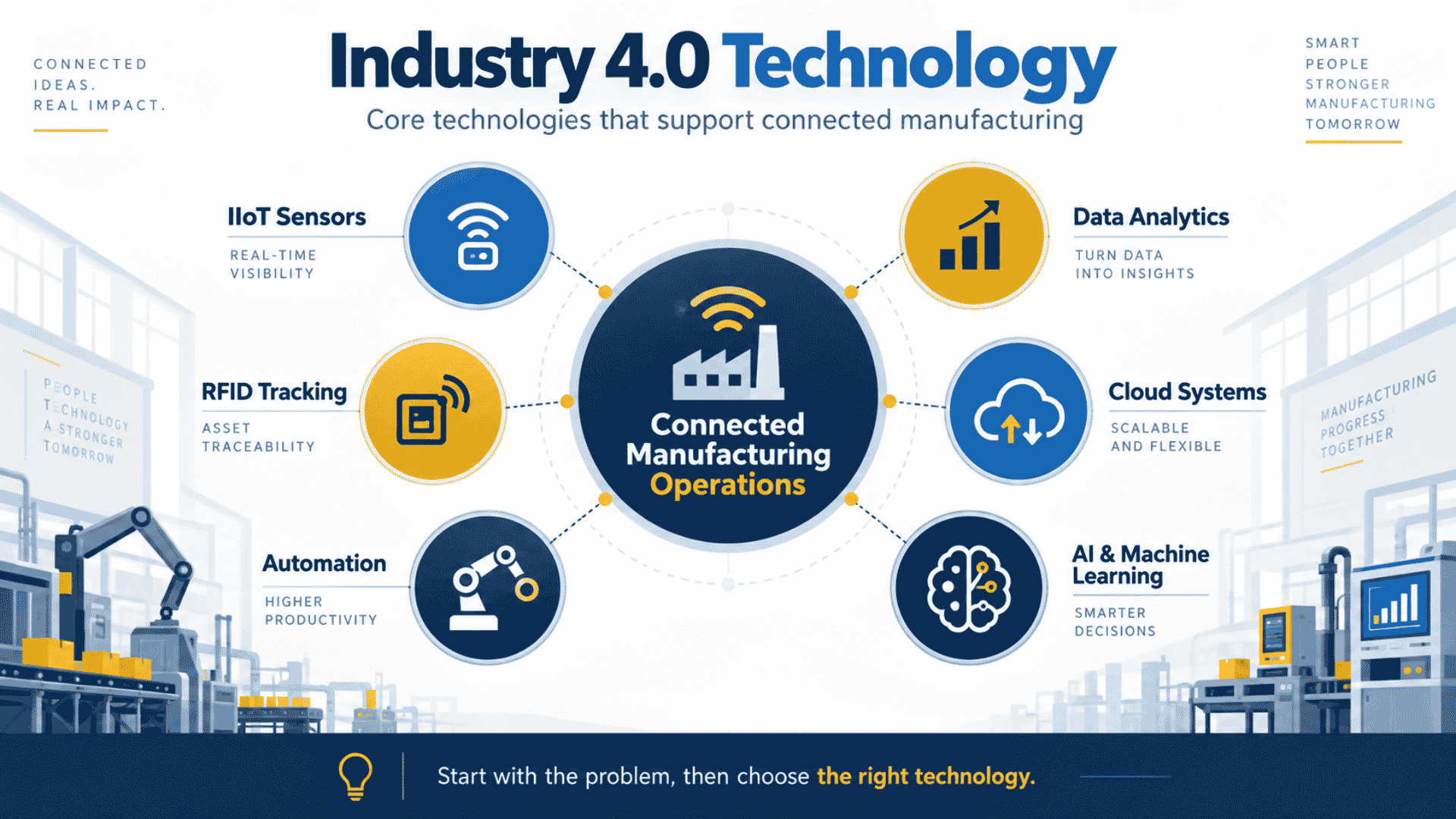
Industry 4.0 Technology: What It Means for Manufacturers in 2026
Industry 4.0 technology connects equipment, software, data, and business systems so manufacturers can improve how work moves through the ope...
Read article
How Letter B Helps MSP's Deliver Digital Transformation
MSP digital transformation is becoming essential as manufacturing clients demand more than infrastructure and support. At Letter B Global Te...
Read article
Where Modern Manufacturing Technology Replaces Legacy Systems in Manufacturing in 2026
Modern manufacturing technology does not require replacing everything at once. Many improvements focus on the areas where inefficiencies hav...
Read article